
Another Way to Say “Trying Times”: Expanding Your Vocabulary
Navigating the complexities of the English language often involves finding diverse ways to express the same idea. When faced with “trying times,” having a rich vocabulary allows for more nuanced and impactful communication. This article explores various alternatives to the phrase “trying times,” providing definitions, examples, and practical exercises to help you enhance your expressive abilities. Mastering these alternatives will not only elevate your writing and speaking but also enable you to connect with your audience on a deeper level. This guide is perfect for English language learners, writers, and anyone looking to expand their vocabulary and improve their communication skills.
This comprehensive guide will delve into various synonyms and alternative phrases that capture the essence of “trying times,” equipping you with the tools to articulate difficult periods with precision and flair. Whether you’re writing an essay, delivering a speech, or simply engaging in conversation, this resource will empower you to express yourself more effectively and eloquently.
Table of Contents
- Introduction
- Definition of “Trying Times”
- Structural Breakdown
- Types or Categories of Alternative Phrases
- Examples
- Usage Rules
- Common Mistakes
- Practice Exercises
- Advanced Topics
- FAQ
- Conclusion
Definition of “Trying Times”
“Trying times” is an idiomatic expression used to describe periods characterized by significant difficulty, hardship, or adversity. It signifies a situation or era marked by challenges that test one’s resilience, patience, and ability to cope. The phrase often implies a sense of stress, pressure, and uncertainty, suggesting that individuals or communities are facing considerable obstacles.
The term can be applied to a wide range of contexts, including personal struggles, economic downturns, political unrest, or natural disasters. It encapsulates the idea that these periods demand strength, perseverance, and often, adaptation. The function of “trying times” in a sentence is to provide a concise and evocative way to convey the presence of significant challenges.
Classification: Idiomatic expression, noun phrase.
Function: To describe periods of difficulty, hardship, or adversity.
Contexts: Personal struggles, economic downturns, political unrest, natural disasters, and any situation involving significant challenges.
Structural Breakdown
The phrase “trying times” consists of two main components:
- Trying: This is the present participle of the verb “to try,” functioning as an adjective. It describes the nature of the times as being testing or challenging. The word “trying” implies that these times put a strain on one’s resources, patience, and abilities.
- Times: This is a plural noun referring to a period or era. In this context, it signifies a specific duration or set of circumstances. The use of the plural form “times” suggests that these difficult experiences are not isolated incidents but rather a sustained period of hardship.
The combination of “trying” and “times” creates a powerful image of a period fraught with difficulties and challenges. The structure is straightforward, yet the impact is significant, effectively conveying the sense of hardship and adversity.
Types or Categories of Alternative Phrases
Several alternative phrases can be used to convey the meaning of “trying times,” each with slightly different nuances. Categorizing these alternatives helps in selecting the most appropriate phrase for a given context.
Challenging Periods
This category emphasizes the difficulty and demands of a particular time. It suggests that the period requires significant effort and resilience to overcome.
Difficult Circumstances
This phrase highlights the unfavorable conditions and situations that make life challenging. It focuses on the external factors contributing to the hardship.
Hardships and Adversities
This category underscores the severe difficulties and misfortunes faced during a particular time. It conveys a sense of significant suffering and struggle.
Times of Trouble
This phrase directly indicates a period marked by problems, difficulties, and unrest. It suggests a state of disruption and uncertainty.
Periods of Suffering
This category emphasizes the pain and distress experienced during a particular time. It conveys a sense of emotional or physical hardship.
Examples
To illustrate the usage of these alternative phrases, the following sections provide examples in various contexts. Each category includes a table with numerous examples showcasing different ways to express the idea of “trying times.”
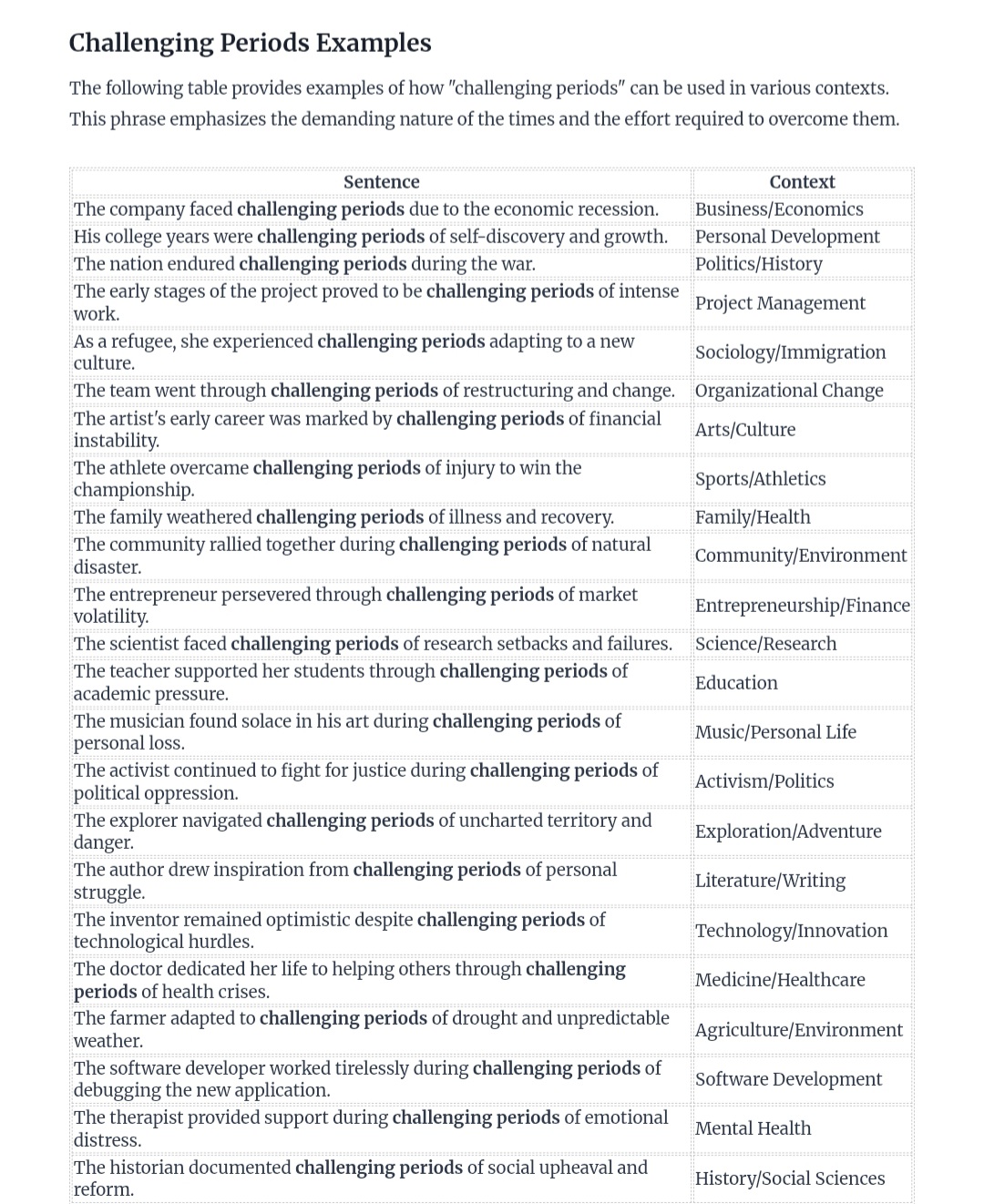
Challenging Periods Examples
The following table provides examples of how “challenging periods” can be used in various contexts. This phrase emphasizes the demanding nature of the times and the effort required to overcome them.
| Sentence | Context |
|---|---|
| The company faced challenging periods due to the economic recession. | Business/Economics |
| His college years were challenging periods of self-discovery and growth. | Personal Development |
| The nation endured challenging periods during the war. | Politics/History |
| The early stages of the project proved to be challenging periods of intense work. | Project Management |
| As a refugee, she experienced challenging periods adapting to a new culture. | Sociology/Immigration |
| The team went through challenging periods of restructuring and change. | Organizational Change |
| The artist’s early career was marked by challenging periods of financial instability. | Arts/Culture |
| The athlete overcame challenging periods of injury to win the championship. | Sports/Athletics |
| The family weathered challenging periods of illness and recovery. | Family/Health |
| The community rallied together during challenging periods of natural disaster. | Community/Environment |
| The entrepreneur persevered through challenging periods of market volatility. | Entrepreneurship/Finance |
| The scientist faced challenging periods of research setbacks and failures. | Science/Research |
| The teacher supported her students through challenging periods of academic pressure. | Education |
| The musician found solace in his art during challenging periods of personal loss. | Music/Personal Life |
| The activist continued to fight for justice during challenging periods of political oppression. | Activism/Politics |
| The explorer navigated challenging periods of uncharted territory and danger. | Exploration/Adventure |
| The author drew inspiration from challenging periods of personal struggle. | Literature/Writing |
| The inventor remained optimistic despite challenging periods of technological hurdles. | Technology/Innovation |
| The doctor dedicated her life to helping others through challenging periods of health crises. | Medicine/Healthcare |
| The farmer adapted to challenging periods of drought and unpredictable weather. | Agriculture/Environment |
| The software developer worked tirelessly during challenging periods of debugging the new application. | Software Development |
| The therapist provided support during challenging periods of emotional distress. | Mental Health |
| The historian documented challenging periods of social upheaval and reform. | History/Social Sciences |
Difficult Circumstances Examples
The following table illustrates how “difficult circumstances” can be used to describe situations of hardship. This phrase emphasizes the unfavorable conditions that individuals or communities face.
| Sentence | Context |
|---|---|
| The family found themselves in difficult circumstances after losing their home. | Personal/Financial |
| The refugees arrived in difficult circumstances, lacking food and shelter. | Humanitarian/Immigration |
| The company struggled to survive under difficult circumstances in a competitive market. | Business/Economics |
| The soldiers fought bravely despite the difficult circumstances on the battlefield. | Military/War |
| The students persevered through difficult circumstances to complete their education. | Education/Personal |
| The community rallied together to overcome difficult circumstances after the earthquake. | Community/Natural Disaster |
| The artist created inspiring works even in the face of difficult circumstances. | Arts/Personal |
| The scientist made breakthroughs despite the difficult circumstances of limited funding. | Science/Research |
| The politician worked tirelessly to improve lives under difficult circumstances of poverty. | Politics/Social Issues |
| The entrepreneur launched a successful business despite the difficult circumstances of a recession. | Business/Entrepreneurship |
| The team achieved victory despite the difficult circumstances of injuries and setbacks. | Sports/Athletics |
| The family remained strong despite facing difficult circumstances of long-term illness. | Family/Health |
| The writer drew inspiration from the difficult circumstances she encountered in her travels. | Literature/Travel |
| The inventor found innovative solutions despite the difficult circumstances of limited resources. | Technology/Innovation |
| The doctor provided compassionate care despite the difficult circumstances of overcrowded hospitals. | Medicine/Healthcare |
| The farmer adapted to sustainable practices despite the difficult circumstances of climate change. | Agriculture/Environment |
| The software engineer debugged the system efficiently despite the difficult circumstances of tight deadlines. | Software Engineering |
| The therapist offered support to clients dealing with difficult circumstances of trauma and loss. | Mental Health |
| The historian documented the resilience of communities facing difficult circumstances of displacement. | History/Social Sciences |
| The social worker assisted families navigating difficult circumstances of poverty and inequality. | Social Work/Community Support |
| The animal shelter rescued and rehabilitated animals from difficult circumstances of neglect and abandonment. | Animal Welfare |
| The construction workers completed the project safely despite the difficult circumstances of hazardous conditions. | Construction Safety/Engineering |
| The disaster relief team provided aid to those affected by difficult circumstances of natural disasters. | Disaster Relief/Humanitarian Aid |
Hardships and Adversities Examples
This table showcases the use of “hardships and adversities” to describe periods of significant suffering and misfortune. The emphasis is on the severe difficulties faced.
| Sentence | Context |
|---|---|
| The pioneers faced numerous hardships and adversities while settling the new land. | History/Pioneering |
| Despite the hardships and adversities, she never lost hope. | Personal/Resilience |
| The economic crisis brought about widespread hardships and adversities for many families. | Economics/Social Impact |
| The war was a time of immense hardships and adversities for the entire nation. | Politics/War |
| The refugees endured countless hardships and adversities during their journey to safety. | Humanitarian/Refugee Crisis |
| The small business owners faced hardships and adversities due to increased competition. | Business/Small Business |
| The athletes overcame hardships and adversities through dedication and training. | Sports/Athletics |
| The patients battled hardships and adversities while fighting their illnesses. | Health/Medicine |
| The artists expressed the hardships and adversities of life through their work. | Arts/Personal Expression |
| The scientists persevered despite the hardships and adversities of research challenges. | Science/Research |
| The community showed resilience in the face of hardships and adversities caused by the natural disaster. | Community/Natural Disaster |
| The family supported each other through the hardships and adversities of financial struggles. | Family/Financial |
| The writers documented the hardships and adversities of marginalized communities. | Literature/Social Issues |
| The inventors persisted through the hardships and adversities of technological failures. | Technology/Innovation |
| The doctors dedicated their lives to alleviating the hardships and adversities of suffering patients. | Medicine/Healthcare |
| The farmers adapted to the hardships and adversities of unpredictable weather patterns. | Agriculture/Environment |
| The software developers worked tirelessly to overcome the hardships and adversities of system failures. | Software Development |
| The therapists provided support to individuals facing the hardships and adversities of emotional trauma. | Mental Health |
| The historians recorded the hardships and adversities of past generations. | History/Social Sciences |
| The volunteers dedicated their time to easing the hardships and adversities of those in need. | Volunteering/Community Service |
| The engineers designed solutions to mitigate the hardships and adversities caused by infrastructure failures. | Engineering/Infrastructure |
| The aid workers provided relief during the hardships and adversities experienced by displaced populations. | Humanitarian Aid |
| The activists fought to address the systemic hardships and adversities faced by disadvantaged groups. | Activism/Social Justice |
Times of Trouble Examples
The following table provides examples of sentences using “times of trouble.” This phrase directly indicates periods marked by problems, difficulties, and unrest.
| Sentence | Context |
|---|---|
| During times of trouble, it’s important to stay calm and focused. | General Advice |
| The community rallied together during times of trouble to support each other. | Community/Support |
| The country experienced times of trouble due to political instability. | Politics/Instability |
| The family faced times of trouble when the main provider lost their job. | Personal/Financial |
| The company navigated times of trouble by implementing cost-cutting measures. | Business/Management |
| In times of trouble, faith and perseverance are essential. | Personal/Spiritual |
| The organization provided aid to those affected during times of trouble after the natural disaster. | Humanitarian/Disaster Relief |
| The team worked together to overcome times of trouble and achieve their goals. | Teamwork/Achievement |
| The nation learned valuable lessons from times of trouble in its history. | History/Learning |
| The artist found inspiration and created meaningful works during times of trouble. | Arts/Creativity |
| The scientists worked tirelessly to find solutions during times of trouble related to the pandemic. | Science/Health |
| The government implemented policies to protect citizens during times of trouble in the economy. | Politics/Economics |
| The writer explored themes of resilience and hope in her novels set during times of trouble. | Literature/Resilience |
| The inventor developed innovative technologies to address challenges during times of trouble. | Technology/Innovation |
| The doctors and nurses worked tirelessly to care for patients during times of trouble in the healthcare system. | Medicine/Healthcare |
| The farmers adapted their practices to ensure food security during times of trouble caused by climate change. | Agriculture/Environment |
| The software engineers developed critical infrastructure solutions during times of trouble related to cybersecurity threats. | Software Engineering |
| The therapists provided mental health support to individuals struggling during times of trouble. | Mental Health |
| The historians documented the experiences of communities during times of trouble and societal upheaval. | History/Social Sciences |
| The social workers provided assistance to vulnerable populations during times of trouble related to poverty and inequality. | Social Work/Community Support |
| The community leaders organized initiatives to support residents during times of trouble related to local economic downturns. | Community Leadership |
| The educators adapted teaching methods to support students during times of trouble linked to school closures. | Education |
| The religious leaders offered spiritual guidance and comfort during times of trouble to their congregations. | Religion |
Periods of Suffering Examples
This table provides examples of how “periods of suffering” can be used in sentences. This phrase emphasizes the pain and distress experienced during a particular time.
| Sentence | Context |
|---|---|
| The war brought about prolonged periods of suffering for the civilian population. | War/Humanitarian Crisis |
| The illness caused intense periods of suffering before a diagnosis was made. | Health/Medical |
| The economic depression led to periods of suffering for many families. | Economics/Social Impact |
| The refugees experienced unimaginable periods of suffering during their displacement. | Refugee Crisis/Humanitarian |
| The animals endured periods of suffering in captivity. | Animal Welfare/Ethics |
| The artist channelled her personal periods of suffering into powerful works of art. | Arts/Personal Expression |
| The scientist dedicated his life to alleviating periods of suffering caused by disease. | Science/Medicine |
| The politician implemented policies to mitigate periods of suffering during economic downturns. | Politics/Economics |
| The writer explored themes of pain and resilience in her novels set during periods of suffering. | Literature/Resilience |
| The inventor developed assistive technologies to improve the quality of life during periods of suffering from disability. | Technology/Disability |
| The doctors provided compassionate care to patients during periods of suffering from chronic illnesses. | Medicine/Healthcare |
| The farmers struggled to maintain their livelihoods during periods of suffering caused by drought. | Agriculture/Environment |
| The software engineers worked to improve system reliability to minimize periods of suffering caused by system failures. | Software Engineering |
| The therapists offered support to individuals dealing with periods of suffering caused by trauma and loss. | Mental Health |
| The historians documented the experiences of communities during periods of suffering in times of war and famine. | History/Social Sciences |
| The volunteers provided relief to those affected during periods of suffering following natural disasters. | Volunteering/Disaster Relief |
| The engineers developed infrastructure improvements to prevent periods of suffering caused by future disasters. | Engineering/Disaster Prevention |
| The activists fought to address systemic issues that contribute to periods of suffering among marginalized communities. | Activism/Social Justice |
| The educators adapted curricula to promote empathy and understanding during periods of suffering in global events. | Education |
| The religious leaders offered spiritual guidance and comfort during periods of suffering to those grieving loss. | Religion |
| The animal welfare organizations worked to rescue and rehabilitate animals during periods of suffering due to neglect. | Animal Welfare |
| The mental health professionals provided counseling to individuals experiencing periods of suffering due to anxiety and depression. | Mental Health Services |
| The humanitarian organizations provided shelter, food, and medical care to those affected during periods of suffering from displacement. | Humanitarian Aid |
Usage Rules
When using alternative phrases for “trying times,” consider the following rules:
- Context: Choose a phrase that accurately reflects the specific context. “Challenging periods” may be appropriate for professional situations, while “hardships and adversities” might be better suited for more serious or personal circumstances.
- Formality: Be mindful of the level of formality. Some phrases, like “times of trouble,” are more informal than others, such as “difficult circumstances.”
- Audience: Consider your audience. Use language that is appropriate for their level of understanding and background.
- Specificity: Be as specific as possible. Instead of simply saying “difficult circumstances,” you could specify the nature of the circumstances, such as “difficult economic circumstances.”
- Nuance: Pay attention to the nuances of each phrase. Some phrases emphasize the difficulty, while others highlight the suffering or adversity.
Common Mistakes
Here are some common mistakes to avoid when using alternatives to “trying times”:
| Incorrect | Correct | Explanation |
|---|---|---|
| The time was very trying. | The times were very trying. | “Times” is plural in this context. |
| We are in a difficult circumstance. | We are in difficult circumstances. | “Circumstances” is generally used in the plural. |
| The hardship was very adversity. | The hardships were very adverse. | Use “hardships” as a plural noun; “adverse” is an adjective. |
| The period of suffer. | The period of suffering. | Use “suffering” as a noun. |
| Challenging period. | Challenging periods. | “Periods” is plural in this context. |
Practice Exercises
Test your understanding with these practice exercises.
Exercise 1: Fill in the Blanks
Fill in the blanks with the most appropriate phrase from the list: challenging periods, difficult circumstances, hardships and adversities, times of trouble, periods of suffering.
| Question | Answer |
|---|---|
| 1. The company faced ______ due to the global recession. | challenging periods |
| 2. The refugees endured ______ during their journey to safety. | hardships and adversities |
| 3. During ______, it’s important to support your friends and family. | times of trouble |
| 4. The patient experienced ______ before the correct diagnosis was made. | periods of suffering |
| 5. The family found themselves in ______ after the unexpected job loss. | difficult circumstances |
| 6. The community showed great resilience during the ______ following the natural disaster. | challenging periods |
| 7. The soldiers fought bravely despite the ______ on the battlefield. | difficult circumstances |
| 8. The nation experienced ______ due to political unrest and economic instability. | times of trouble |
| 9. The artist’s early life was marked by ______, which influenced her work. | hardships and adversities |
| 10. The patients with chronic illnesses often experience prolonged ______. | periods of suffering |
Exercise 2: Sentence Rewriting
Rewrite the following sentences using an alternative phrase for “trying times.”
| Original Sentence | Rewritten Sentence |
|---|---|
| 1. The company faced trying times due to the pandemic. | The company faced difficult circumstances due to the pandemic. |
| 2. The refugees experienced trying times as they sought refuge in a new country. | The refugees endured hardships and adversities as they sought refuge in a new country. |
| 3. During the trying times of the recession, many people lost their jobs. | During the difficult circumstances of the recession, many people lost their jobs. |
| 4. The patient went through trying times while battling cancer. | The patient experienced periods of suffering while battling cancer. |
| 5. The community faced trying times after the devastating earthquake. | The community faced challenging periods after the devastating earthquake. |
| 6. Navigating a new career during trying times can be daunting. | Navigating a new career during difficult circumstances can be daunting. |
| 7. The family supported each other during the trying times of their father’s illness. | The family supported each other during the periods of suffering related to their father’s illness. |
| 8. The nation emerged stronger after the trying times of war. | The nation emerged stronger after the hardships and adversities of war. |
| 9. The students persevered through trying times to complete their education. | The students persevered through difficult circumstances to complete their education. |
| 10. In trying times, it’s important to maintain a positive attitude. | During times of trouble, it’s important to maintain a positive attitude. |
Exercise 3: Contextual Usage
Choose the most appropriate alternative phrase for “trying times” in the following scenarios.
| Scenario | Phrase Options | Correct Answer |
|---|---|---|
| 1. Describing the aftermath of a natural disaster that caused widespread devastation. | a) Challenging periods b) Hardships and adversities c) Difficult circumstances | b) Hardships and adversities |
| 2. Discussing a company’s financial struggles due to a market downturn. | a) Times of trouble b) Challenging periods c) Periods of suffering | b) Challenging periods |
| 3. Referring to the personal struggles of a refugee family. | a) Difficult circumstances b) Periods of suffering c) Times of trouble | a) Difficult circumstances |
| 4. Describing the experience of a patient battling a chronic illness. | a) Challenging periods b) Periods of suffering c) Hardships and adversities | b) Periods of suffering |
| 5. Talking about a period of political and social unrest in a country. | a) Difficult circumstances b) Times of trouble c) Challenging periods | b) Times of trouble |
| 6. Reflecting on the struggles faced by pioneers settling new lands. | a) Challenging periods b) Hardships and adversities c) Difficult circumstances | b) Hardships and adversities |
| 7. Describing a student’s experience juggling work and studies. | a) Difficult circumstances b) Challenging periods c) Times of trouble | b) Challenging periods |
| 8. Referring to the emotional toll of a long-term illness on a family. | a) Periods of suffering b) Difficult circumstances c) Times of trouble | a) Periods of suffering |
| 9. Talking about the economic impact of a global pandemic. | a) Challenging periods b) Times of trouble c) Difficult circumstances | a) Challenging periods |
| 10. Describing the experience of individuals facing discrimination and inequality. | a) Difficult circumstances b) Hardships and adversities c) Periods of suffering | b) Hardships and adversities |
Advanced Topics
For advanced learners, consider exploring the following:
- Figurative Language: Explore how metaphors and similes can be used to describe “trying times” in a more vivid and evocative way.
- Historical Context: Research how different historical periods have been described using various phrases and expressions.
- Cultural Variations: Investigate how different cultures express the concept of “trying times” in their languages and idioms.
- Literary Analysis: Analyze how authors use language to portray difficult periods in their works.
FAQ
Here are some frequently asked questions about alternative ways to say “trying times”:
- What is the best alternative phrase for “trying times”?
The “best” alternative depends on the specific context and the nuance you want to convey. “Challenging periods” is suitable for professional settings, while “hardships and adversities” is appropriate for more serious situations. Consider the specific circumstances and choose the phrase that best reflects the situation.
- Are there any informal alternatives to “trying times”?
Yes, phrases like “tough times” or “rough patch” are more informal alternatives. These phrases are suitable for casual conversations but may not be appropriate for formal writing or presentations.
- Can I use “difficult times” instead of “trying times”?
Yes, “difficult times” is a perfectly acceptable
alternative. It is a straightforward and widely understood phrase that conveys the same general meaning.
- How can I improve my vocabulary to better express difficult situations?
Read widely, pay attention to the language used in different contexts, and actively practice using new words and phrases in your writing and speaking. Use a thesaurus to explore synonyms and alternative expressions.
- Is it ever inappropriate to use alternative phrases for “trying times”?
Yes, it can be inappropriate if the phrase does not accurately reflect the severity or nature of the situation. For example, using “challenging periods” to describe a catastrophic event would be a misrepresentation. Always consider the context and choose a phrase that is both accurate and respectful.
Conclusion
Mastering alternative ways to express “trying times” enhances your communication skills and allows you to articulate difficult periods with greater precision and impact. By understanding the nuances of phrases like “challenging periods,” “difficult circumstances,” “hardships and adversities,” “times of trouble,” and “periods of suffering,” you can choose the most appropriate language for any given context. This guide has provided definitions, examples, usage rules, and practice exercises to help you expand your vocabulary and improve your ability to express complex ideas effectively. Continue to practice and explore new ways to articulate the challenges and triumphs of the human experience.

